

A Good Weed
A Saturday morning at Fitzroy Town Hall, a song to open the room, and a question I haven’t been able to put down: how do you be a good weed in a place that’s not your own?

I went to a library talk on a Saturday morning and I haven’t stopped thinking about it since.
Well… that feels like underselling it. Let me try again.
I walked into the Fitzroy Town Hall ballroom—which the Yarra Public Library had somehow claimed for a morning, which is the kind of thing public libraries do that makes me want to cry a little (the sheer democratic nerve of it!!)—and Leah Manaema Avene opened with a hum. Not an introduction. Not a land acknowledgement in the way I’ve learned to expect one, sincere but brief, before we move on. A hum, that became a song, that woke something up in the room before a single word was truly spoken.
She was opening the Va, though I didn’t know that word yet.
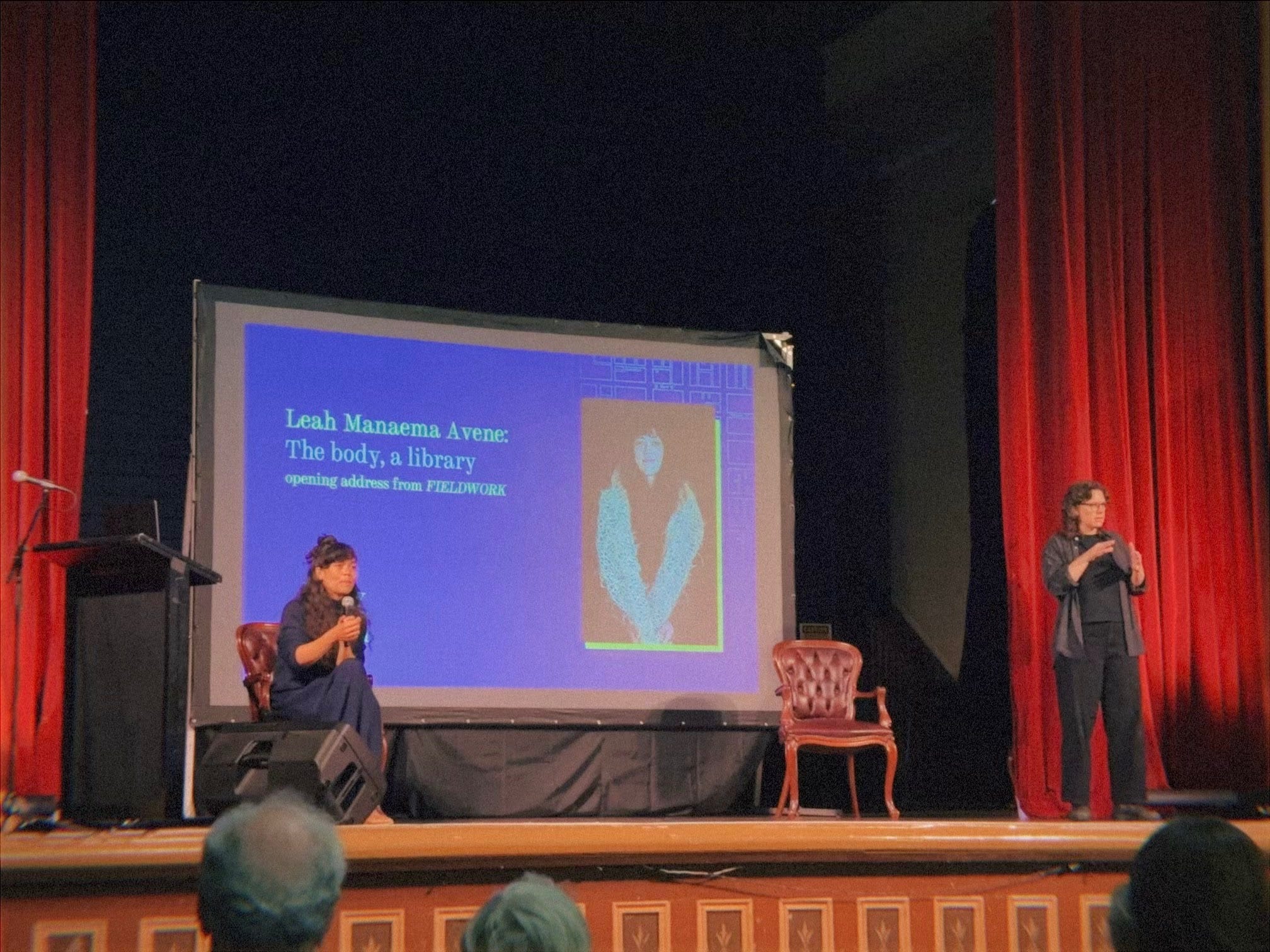
Va is a Tuvaluan concept (Leah is Tuvaluan-Irish, raised on Kulin lands) that describes the space between things. Not the gap that separates, but the connective tissue. The in-between as the place where relation actually lives. When we sing, when we dance, when we turn toward each other… we awaken the Va. We make the connection present. “Individualism,” she said, “puts all the pressure on us as singular selves.” When we think about Va instead, we can sit back. We can sing in. We can decompress. “This,” she said, “is the work of decolonising.”
I hadn’t heard of Leah before that morning. I didn’t know I was about to be handed language I’d been looking for without knowing its name.
Speaking in Collages
If you’ve read my post on learning to become kin, you’ll know I’ve been sitting with a question I can’t quite resolve: how do you live with integrity as a settler on land that isn’t yours? Not theoretically. Actually. Day by day, in your body, in your relationships, in the way you move through a country that holds you without having asked for you. I’ve been circling it. I wrote in that post that I felt the edges of something but not the through-line.
Leah spoke that morning the way she described all good storytelling—in collages, in leaving gaps in the truths so others can fill them with their own. She wasn’t delivering a lecture, but weaving something with the room, and leaving enough space that you could find yourself in it.
I found myself in it almost immediately.
The Wounding
Leah brought out a small, unassuming rug, holding it dearly as she explained it was her birth mat—a woven mat, made for her before she was born, that she can read. It was beyond reading the letters that make up her name… it was like she was tracing the patterns to learn stories of the plants, the water, the pigments, the people. Her first text, she called it. “I wish I could read it better,” she said. “Read the depths of it.” There was grief in that sentence, and also love, and also a kind of orientation towards the knowledge that lives in made things, in inherited objects, in the hands that shaped them before you arrived.
Then she said: the urgency of capitalism had her assimilating hard, and violently, and she left her culture.
She said it plainly, without self-pity. Just: this is what happened. This is what it does. She is Tuvaluan-Irish, raised here, and she knows what it is to be pulled away from yourself by the gravity of a system that wants you legible, productive, assimilated. She said it in the same breath as talking about her birth mat—the thing she can almost read but not quite—and I understood that the distance between those two things is the wound that her work is trying to close.
Only Half the Prayer
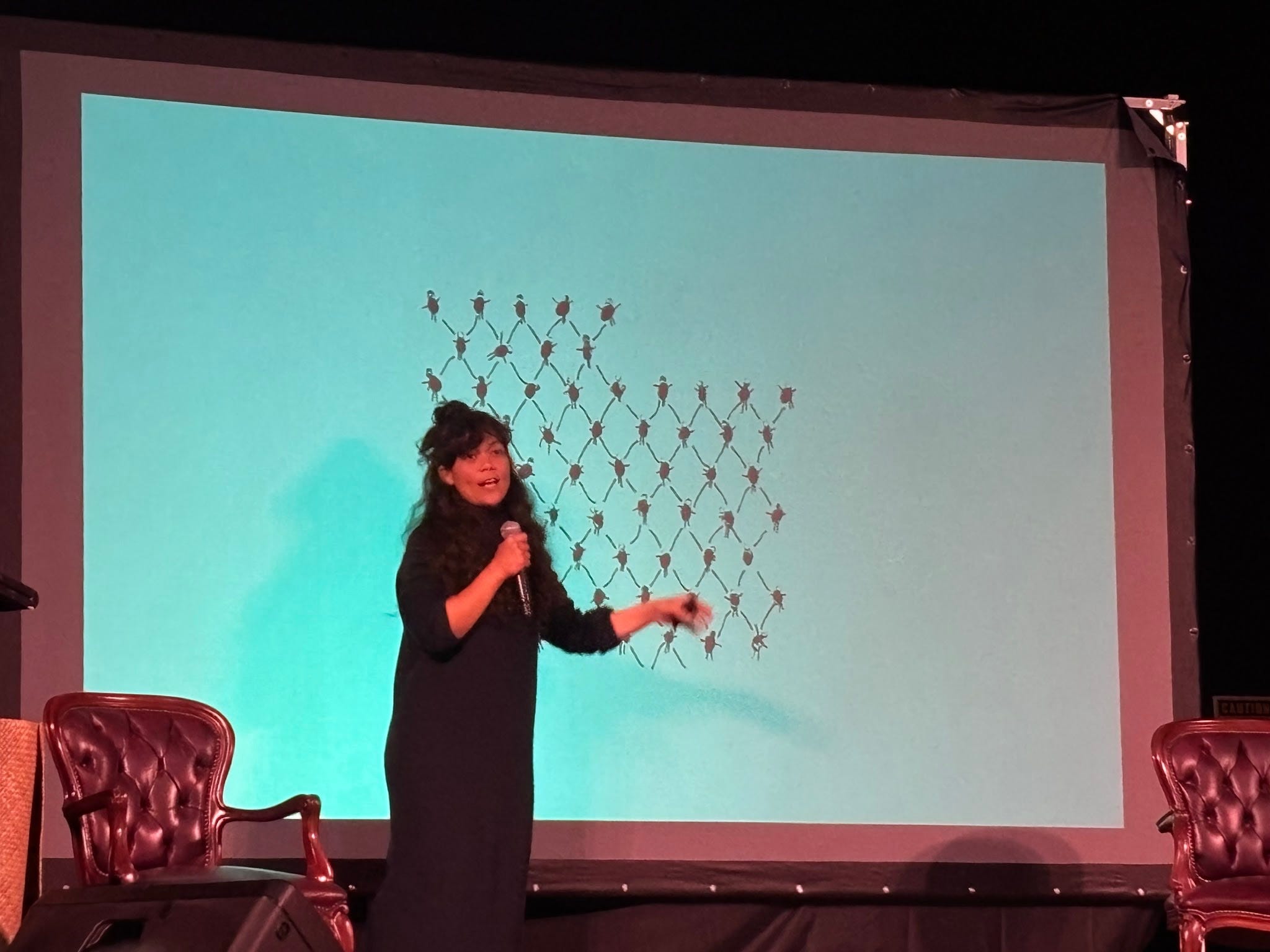
She showed us a framework she calls a kupanga, a Tuvaluan word for a body of knowledge, a type of weaving, like casting a net to fish. She was careful: this is just a framework. I don’t have all the instructions. I’m learning too.
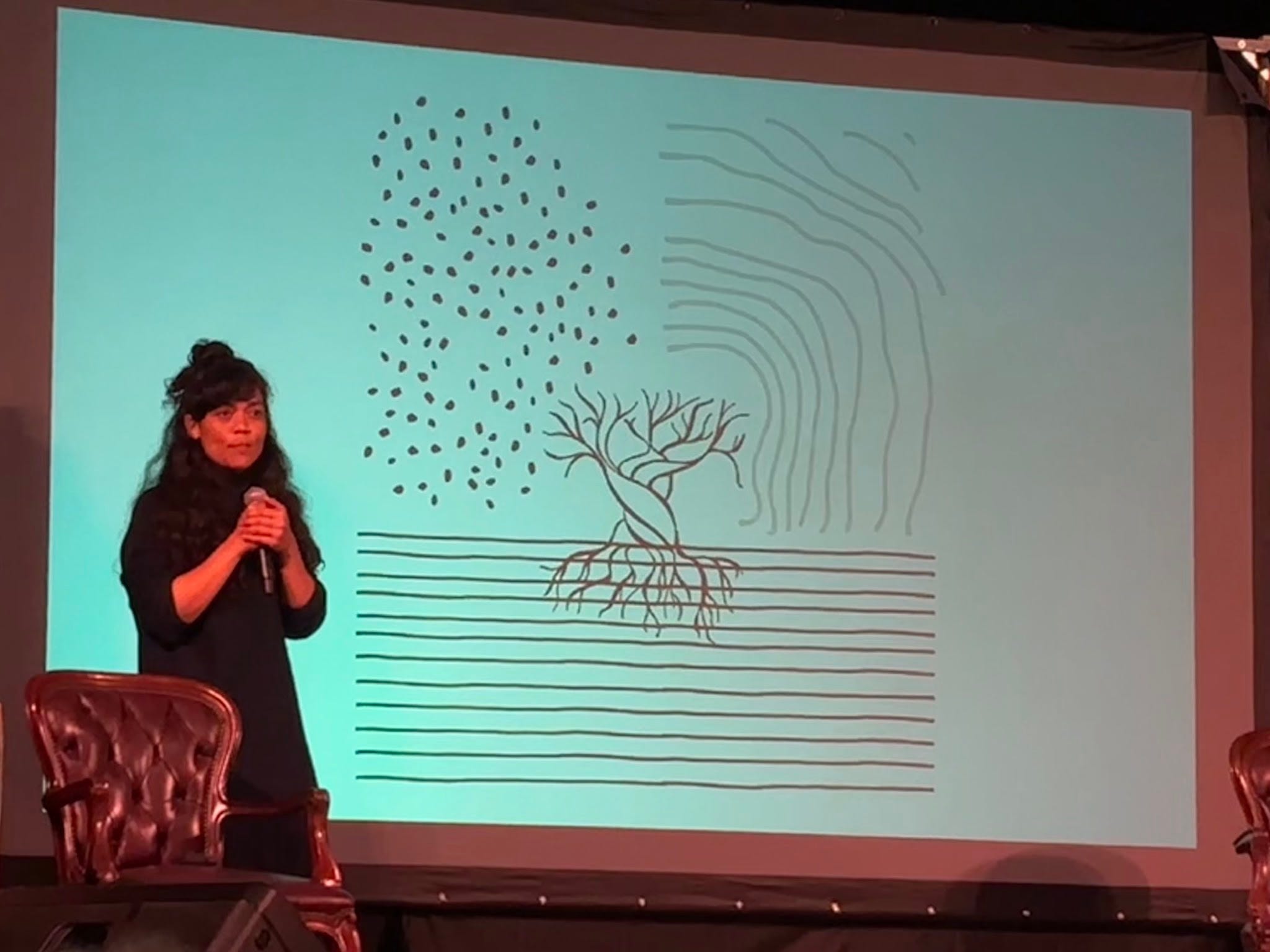
The image stayed with me. On the right: the colonised brain. The mind positioned as the supreme centre of all knowing, isolated, certain of its authority. On the left: indigenous thinking, knowledge carried not in the isolated mind but through the body, through generations, through an umbilical cord of memory and practice that connects us across time. “We are remembering”, she said, “on a cellular level, how to do things.” At the bottom of the image: a plant used in indigenous ceremony. And hands, because knowledge passes through hands. Because the archive is the body, not the institution.
She talked about the field, called fanua, and fingerprints. Layers of time building up rather than moving in a line. “You can see it in rock,” she said. “The way the earth keeps record not as a document but as depth.” The fingerprints are the echoes out. The tree at the centre is the cycle of life—no fear in it, just is. The tendrils reaching from it are culture. Colonisers try to limit by cutting access to ancestral knowledge, by removing autonomy over the future. But the roots are still there. The body still knows.
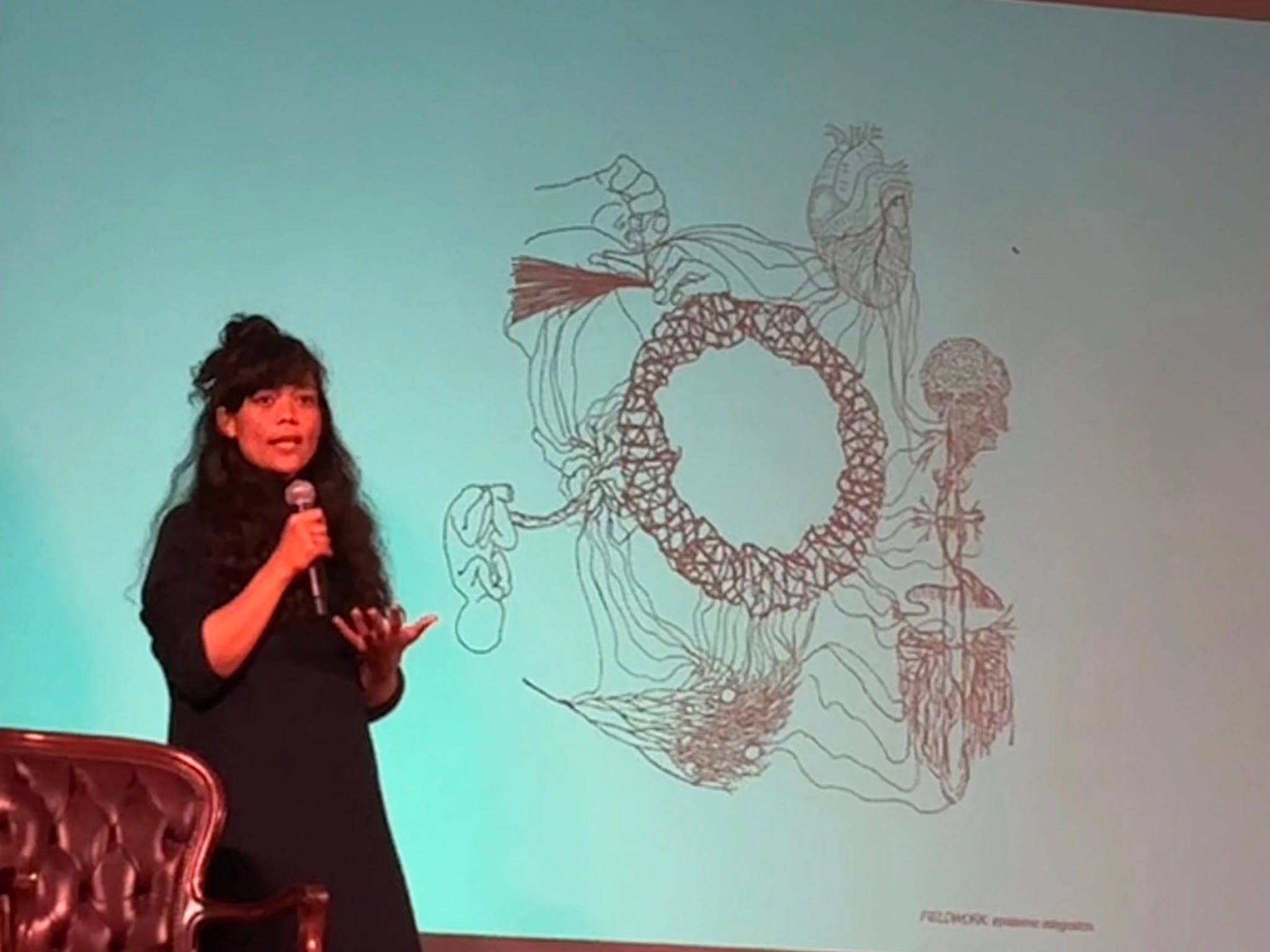
“This is the fracturing,” she said. “This is what colonisation does. We mirror empire within ourselves.” We create systems inside us that fragment us the same way empire fragments communities. We do it to each other. We do it to ourselves.
She said: “Fuck the system is only half the prayer. We need to ask what we are building in its place.”
I wrote it down and underlined it twice. I have been half-praying for years.
The Devotion
She talked about grief. About how empire crumbles within us when it crumbles in the world, how terrifying it is to feel the floor shift under systems you were shaped by, even when you wanted rid of them. “We want to grieve in private,” she said. “We have to learn to grieve out loud. Together.” When empire crumbles, it crumbles inside us too, and we need each other in that.
I sat with that for a long time. I think I have been grieving in private. The grief of being a settler who is new to this country and feels a love for this land and knows that love is complicated and maybe even part of the problem. The grief of not knowing how to hold that without either performing it or collapsing into it.
She said that we have to have the courage to hold the grief that comes with the connection: to country, to culture, to love. That we must devote ourselves to the restoration of humanisation and right relationship.
Devote is a strong word. It is the right word.
Survival
She mentioned the net, the weaving design from her kupanga. “We don’t need direct connections or hoarding of knowledge,” she said. “What we need is to nurture good relationships in every direction.” A web of relation. Not a hierarchy of knowing but a net for fishing, strong because of how it holds together, not because of any single thread.
At one point she mentioned a Warrung phrase, noon gotchan: translated loosely as thank you, though she was clear it resists direct translation. The gratitude is so embedded in the relationship that the thanks can almost dissolve. You don’t name it because it’s just the texture of the connection itself. I am in your presence, you are in mine.
I want to share that with you and I also feel uncomfortable sharing it. I’m not Warrung. I’m not indigenous to this land or any land in the way that phrase carries. But Leah spoke directly to this tension, quoting her mentor Tookey: “I don’t care whose body my language is in. I just need it to survive.” She said it is her responsibility to share language even when it sits uncomfortably—because we need complexity for survival.
I’m choosing to name it here because Leah named it, and because pretending I didn’t receive it would be its own kind of erasure. But I want the discomfort visible. It should be visible.
Becoming a Good Weed
The image I keep returning to: how do you be a good weed in a place that’s not your own?
Leah asked it as a genuine question. A non-indigenous plant in native land; not invasive by nature, just present somewhere it didn’t originate, trying to figure out what it owes, what it can offer, how to grow without crowding. How to be, without taking over.
That’s my question. That’s the becoming kin question, finally named in a way I can hold.
She talked about people, many of them white, who have restored relationships, who have found a throughline of love and survival. She said, “Denying my inheritance as a settler is so radical.” That the flooding of love that was always meant for you will come through.
I don’t know exactly what that means for me yet. But I believe it. Or I’m learning to.
She called it coming home-work instead of homework. The slow, daily, relational labour of learning where you are and who you’re responsible to and what it means to belong to a place you didn’t come from. Not a destination. A practice. A net you keep weaving, in every direction, for as long as you’re here.
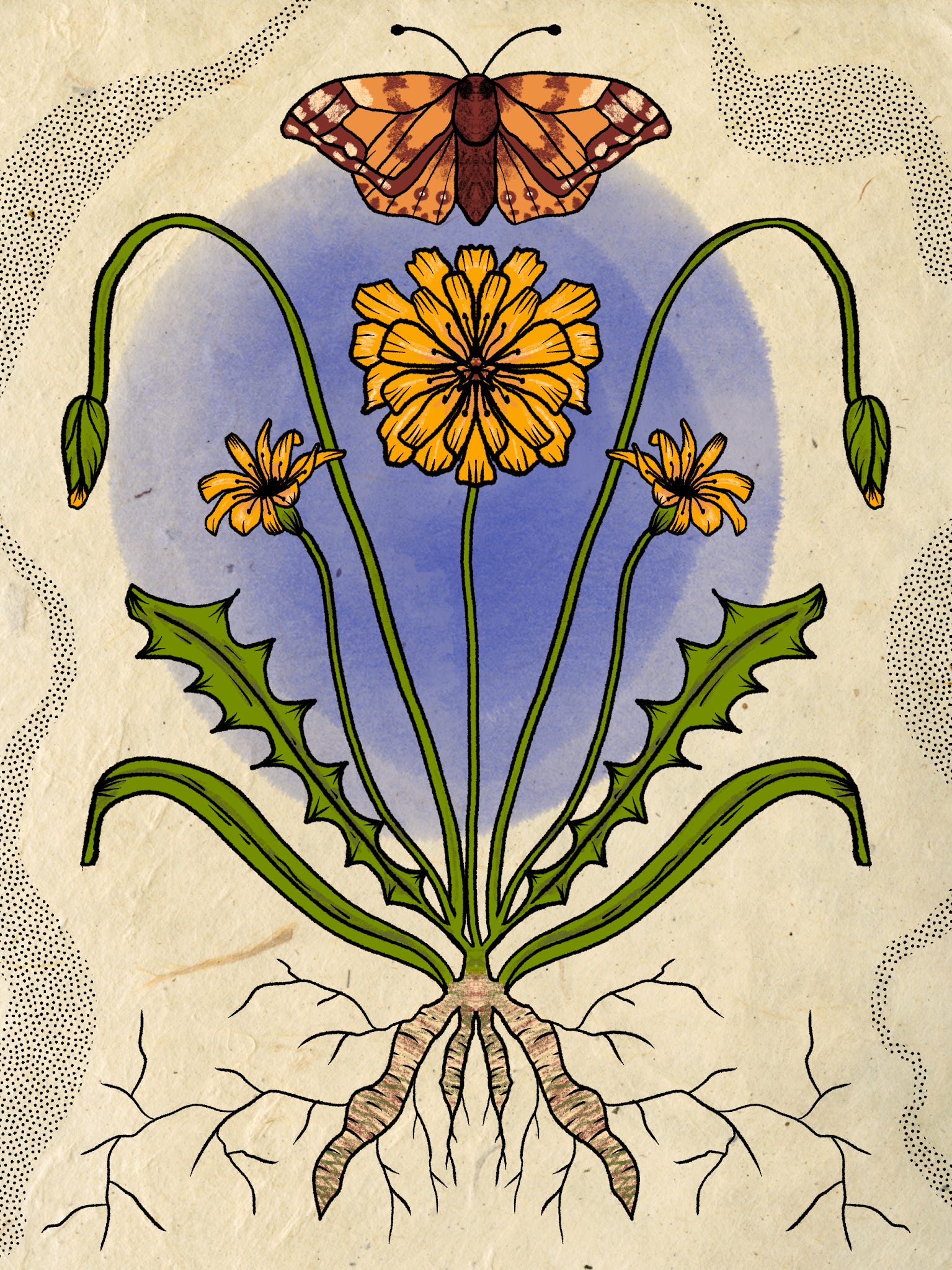
My newest drawing was inspired by Leah’s question: how do you be a good weed in a place that’s not your own? I chose the yam daisy, a plant that is fairly similar to the dandelions I’m used to back home. Murnong, as it’s known in the Woiwurrung language, had fed Wurundjeri people on this country for tens of thousands of years, nearly wiped out by sheep hooves compacting the plains in the 1840s. I don’t think it’s a weed at all, but a staple, now critically endangered, slowly being restored. I’m still sitting with what it means that I reached for this image when I was trying to understand my own smallness here. Thanks to Mallee Conservation for the reference photos and more detailed information on the Murnong/Yam Daisy.
In the Collapse
Leah closed every session, she told us, with: “I love you and I need you.”
She said it’s hard to say. That we need to say it anyway. That in the collapse of empire, we need each other, and we have to be willing to say so out loud.
I love you and I need you.
Leah Manaema Avene (she/they) is a Tuvaluan-Irish psychotherapist, educator, researcher and cultural worker based on Kulin lands. FIELDWORK: Collective Recovery from Colonial Fragmentation Disorder is her book, read aloud, not printed, to small groups, as an act of restoring oral culture. You can find her work at coculturecommunication.com.
yes to becoming good weeds. what a beautiful story and offering to receive, and I'm so grateful you had this experience and shared it with us.
the drawing of the yam daisy is stunning.
I love you and I need you. <3